Incoherence (stress)
Chaotic heart rhythm
 Martin HoolmaDreamlife Mentor
When your body is in stress, no good thought will help. The body decides before you get to think.
Coherence is the state where your heart, mind and emotions work together.
Unlike a mood, it's a skill you can switch on.

Coherence is your inner balance. The state where you're clear, calm and present. Even when the situation isn't.
And here's the most common misunderstanding.
So you pull yourself together and decide to think more positively. A week later you're in exactly the same place.
Because the problem isn't in your thoughts. It's in your body — in a nervous system that has got stuck in stress mode.
You can't think your way out of that.
The way out is through the body.
Your heart never beats like a metronome. The time between beats changes constantly. That pattern shows what's going on inside you.
Incoherence (stress)
Chaotic heart rhythm
Coherence (balance)
Steady heart rhythm
The biggest change isn't that you're calm all the time. Life doesn't get easier.
What changes is that a pause appears between the event and your reaction — a moment of coherence.
Event→Reaction
Event→Pause→Your choice
The child is screaming. Your boss messages. The car won't start. Before, you went along with it automatically. Now there's a moment — and in that moment, you choose.
It's a small thing, and it changes everything.
And the more you practise, the less effort it takes. Your nervous system starts to treat balance as the familiar state and finds its way back there on its own. This isn't a new way of thinking. It's changing your internal setting.

It took me four hard years to find this.
It doesn't have to take you that long. Read my story →
Coherence isn't a matter of belief.
You can see it.
The HeartMath® sensor measures the pattern of your heart rhythm and shows you on your phone, in real time, which state you're in. You don't have to guess whether the practice "went well". You can see it.
That's what makes coherence a skill rather than a belief. And it's what convinces the most doubtful people. View the sensor →
HeartMath® Institute studies with over 14,000 participants associate 6–9 weeks of regular coherence with better mental and emotional wellbeing:


"By nature I'm a big skeptic, and I've always looked at all kinds of spiritual topics with an open but doubtful mind. At some point, though, I realised that I couldn't move forward with my mind alone."
Coherence is a skill. Like any skill, you learn it by practising. Fastest when someone shows you how.
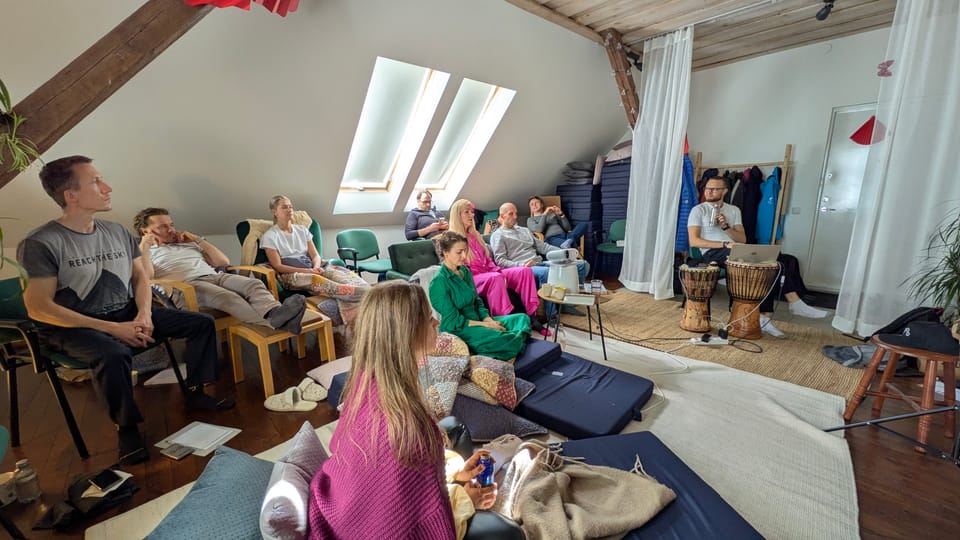
With me, you learn the HeartMath® techniques and practise them with the sensor, so you can see straight away whether it's working.
You can't think your way there.
You can learn it.